

Values and Rules for a Better Life in the Quran

Seeking Clarity In Important Moments?
Book a spiritual guidance session with Dr. Syed Hasan Sardar.
The Quran presents Islam not only as a faith, but as a comprehensive way of life. It provides guidance for humanity’s relationship with God, with oneself, with family and neighbors, with society, and with people of different beliefs. Its aim is to cultivate individuals and communities founded on faith, practical responsibility, and noble character—bringing goodness and mercy to human life.
Developing a daily connection with these teachings and building a consistent bond with the Holy Quran can transform the way we understand ourselves, our purpose, our faith, and our relationship with Allah. Regular engagement allows a person to benefit from its wisdom in both worldly life and the Hereafter.
12 Core Values and Rules for a Better Life
- Return to the Fitrah: The Quran calls people back to their natural, sound human disposition (fitrah)—the innate capacity to recognize truth and goodness. It says: “Adhere to the Fitrah of Allah upon which He has created [all] people” (30:30).
- Use Reason and Seek Knowledge: Faith is not presented as a rejection of intellect. The Quran repeatedly asks people to think, reflect, observe, and reason. It asks whether people will not use their minds (22:46) and states that its examples are understood by “those of knowledge” (29:43).
- Live with Moderation and Foresight: The Quran teaches balance between worldly life and the Hereafter. People should benefit from the world without making it their ultimate purpose: “Seek… the home of the Hereafter; and do not forget your share of the world” (28:77).
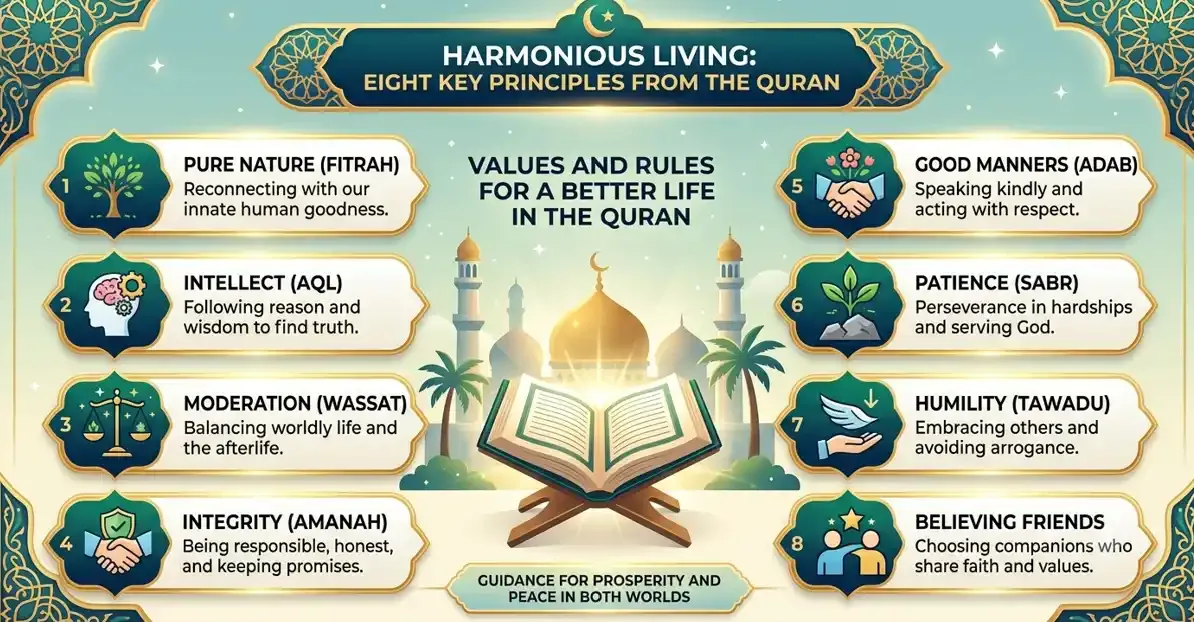
- Practice Honesty and Responsibility: Truthfulness, keeping promises, and fulfilling responsibilities are essential to a healthy society. The Quran commands believers to “speak words of appropriate justice” (33:70) and emphasizes that truthfulness ultimately benefits those who remain truthful (5:119).
- Cultivate Good Manners: The Quran connects moral character with everyday conduct. It teaches people to speak respectfully, control their voices, behave with dignity, and avoid unnecessary harshness (31:19). Good manners transform values into visible behavior.
- Develop Patience and Perseverance: Ṣabr—patience, endurance, and steadfastness—is repeatedly emphasized in the Quran. Whether facing hardship, resisting temptation, or fulfilling responsibilities, perseverance is essential: “Persevere and endure… that you may succeed” (3:200).
- Practice Humility: The Quran discourages arrogance and calls believers to humility in their speech and relationships. The Prophet Muhammad was instructed to “lower your wing” toward believers (26:215). Humility strengthens social relationships and protects a person from pride.
- Avoid Backbiting, Slander, Ridicule, and Harm: The Quran strongly condemns backbiting, slander, ridicule, fault-finding, and harming others. It compares backbiting to eating the flesh of one’s dead brother (49:12) and warns against those who harm others through false accusations (33:58).
- Choose Friendships Wisely: Companionship shapes character. The Quran warns against relationships that pull people toward wrongdoing and reminds humanity that some friendships may become sources of regret in the Hereafter (25:28). By contrast, relationships founded on righteousness have lasting value (43:67).
- Honor and Care for Parents: Respect for parents is given exceptional importance. The Quran commands kindness to them, particularly in old age, even prohibiting expressions as small as “uff” (17:23). It highlights maternal sacrifices and calls people to gratitude toward both God and their parents (31:14).
- Reject Prejudice and Obstinacy: The Quran warns against ʿasabiyyah—chauvinistic or tribal prejudice—and against stubbornly following inherited assumptions without reflection (48:26). Prejudice, blind imitation, and obstinacy prevent people from recognizing truth and exercising sound judgment.
- Make God the Ultimate Purpose: All these values ultimately lead toward a life centered on God. The Quran declares: “Indeed, my prayer, my rites of sacrifice, my living and my dying are for Allah, Lord of the worlds” (6:162–163). Faith gives moral life its deeper purpose.
Make the Quran Part of Daily Life
The Quran’s vision of a better life is comprehensive: return to your natural goodness, think and seek knowledge, live with balance, speak truthfully, practice good manners, remain patient, stay humble, avoid harming others, choose good companions, honor your parents, reject prejudice, and keep God at the center of your life. As the Quran reminds us, “Whoever relies upon Allah—then He is sufficient for him” (65:3).
Reading, understanding, reflecting upon, memorizing, and applying its teachings can gradually transform a person’s character and outlook. For those wishing to strengthen their Quran recitation and memorization, structured learning can make the journey easier and more consistent.
Istekhara.in offers online Quran reading and memorization classes designed to help students develop a stronger and more meaningful connection with the Word of Allah.
Read the Quran. Reflect upon its message. Build a lasting connection with it—and allow its guidance to shape your life.
Book a Session or Join Classes to deepen your journey with structured, authentic guidance.